You Can Screen Everything
October 22, 2026
|
|
Welcome to TrustWorks On Call, here with your healthcare business and strategy 411 for the week. If you enjoy our work, please consider forwarding it along to a friend and encouraging them to subscribe.
This week, we go Beyond the Whiteboard to map how every corner of healthcare is racing up its own ladder of AI efficiency, before Dialing In on the pending regulatory approval of Grail’s multicancer blood test, which just happens to be in the news as Theranos founder Elizabeth Holmes returns to our lives via a strange and compelling documentary. But first the news, starting with Kaiser Permanente’s Risant Health landing its third health system, and its first since its founding CEO stepped down.
|
Behind the Headlines
Unpacking the forces driving healthcare's biggest stories.
|
1. Risant to add INTEGRIS Health as third system.
- Oklahoma City-based INTEGRIS Health, the state’s largest nonprofit system with 20 hospitals and $3.3B of annual revenue, signed a definitive agreement to join Kaiser Permanente’s Risant Health, pending regulatory approvals.
- INTEGRIS is set to become the third health system to join Risant, following Greensboro, NC-based Cone Health and Danville, PA-based Geisinger, both of which closed in 2024, and the first under interim CEO Dale Maxwell, after Risant’s founding CEO Jaewon Ryu, MD, stepped down in July.
TrustWorks Take: When Kaiser Permanente created Risant Health in 2023, its stated goal was to assemble five or six systems with $30–35B in combined revenue within five years. Three systems in, Risant is roughly on pace for the number of deals, but behind on revenue: Geisinger and Cone brought roughly $11B in revenue when they joined, and INTEGRIS will bring that up to about $14B. Larger regional systems have yet to bite, perhaps because they are doing well enough on their own. INTEGRIS, which posted a negative margin in 2025, announced layoffs and clinic closures this spring, as it projects to lose $130M a year from federal spending cuts. Risant’s value-based care capabilities may prove transformative in the long run for INTEGRIS, but the system first needs help shoring up operations and getting back to positive cash flow.
Kaiser Permanente has yet to provide sufficient standalone financial or operating results to evaluate Risant's performance, much less distinguish the contributions of value-based care from traditional revenue growth, operational improvement, and investment returns. While it has reported on select measures (e.g. faster emergency department throughput at Geisinger Medical Center), the evidence supporting Risant's broader value-based care proposition remains limited. In all fairness, it is too early to tell. We are still rooting for the partnership to work, as Risant offers a unique value proposition for systems looking for scale with a nontraditional partner.
|
|
|
2. NIH hospital board rebukes RFK Jr. over vaccine injury clinic.
- The National Institutes of Health (NIH) Clinical Center’s advisory board voted unanimously to support a statement from its chair, Jack Leslie, criticizing Department of Health and Human Services (HHS) Secretary Robert F. Kennedy Jr.’s rollout of a new Vaccine Injury Center at the NIH hospital.
- Kennedy opened the center earlier this month during an unannounced visit with no press present, joined by families holding “Vaccine Injured” signs; the NIH has released few details on its leadership, budget, or study design.
TrustWorks Take: The surreptitious launch of the vaccine injury clinic, with NIH campus staff told to work from home and no press present, fits a pattern under Secretary Kennedy’s leadership. His antivax sentiments are seen as a political liability ahead of the midterms, but he has continued to prioritize the issue behind the scenes. This administration’s more public efforts at changing vaccine policy so far, through advisory committees, rulemaking, and the courts, have proven slow and contested, with federal court blocking key parts of the narrowed childhood vaccine schedule this spring. So instead, HHS is doing what it can by fiat: opening a clinic, proposing a billing code for injury reports, and steering what gets studied.
The NIH board’s strong rebuke is an encouraging sign there are still factions within HHS willing to stand up publicly for evidence-based science. The board is advisory and cannot stop the clinic, but a unanimous public statement was the strongest tool it had. Leslie, its chairman, called serious vaccine injuries “rare but real”, while warning that the launch has already marred the research’s credibility: “If this research finds evidence of harm, many will dismiss it as the work of a secretary who has long argued that vaccines are dangerous. If it finds none, patients will be told that the clinic was a sham.” Without trust in the process or the people leading it, the results of these studies are worthless and serve no one.
|
|
|
3. CMS pushes more transparent MA provider directories.
- The Centers for Medicare and Medicaid Services (CMS) proposed a rule requiring Medicare Advantage (MA) plans to verify provider directory listings every 90 days, remove out-of-network providers within five business days, and display letter-grade accuracy scores starting in 2029.
- The rule would also bar Part D pharmacy benefit managers from collecting fees tied to drug prices or rebates starting in 2028; comments are due Dec. 15.
TrustWorks Take: Inaccurate provider directories are one of the more frustrating experiences in healthcare, and the problem is not confined to MA. A new study of commercial mental health directories found inaccurate information on 56 percent of calls answered by a human (rather than an answering machine or automated phone tree), and fewer than a quarter resulted in an appointment scheduled with the listed clinician. Holding plans accountable for this is overdue, but accuracy is not the same as access. A directory can correctly identify a physician as participating in a network while failing to tell patients whether they can actually obtain an appointment.
The rule also increases the burden on providers, since plans must write data-maintenance duties into provider contracts. Practices already spend an estimated $2.76B a year maintaining directory data, across an average of 20 health plan contracts. Without a more standardized approach to collection and updates, we invite another layer of administrative work without fully resolving the underlying problem. |
|
|
Beyond the Whiteboard
Visualizing key trends from the healthcare industry

|
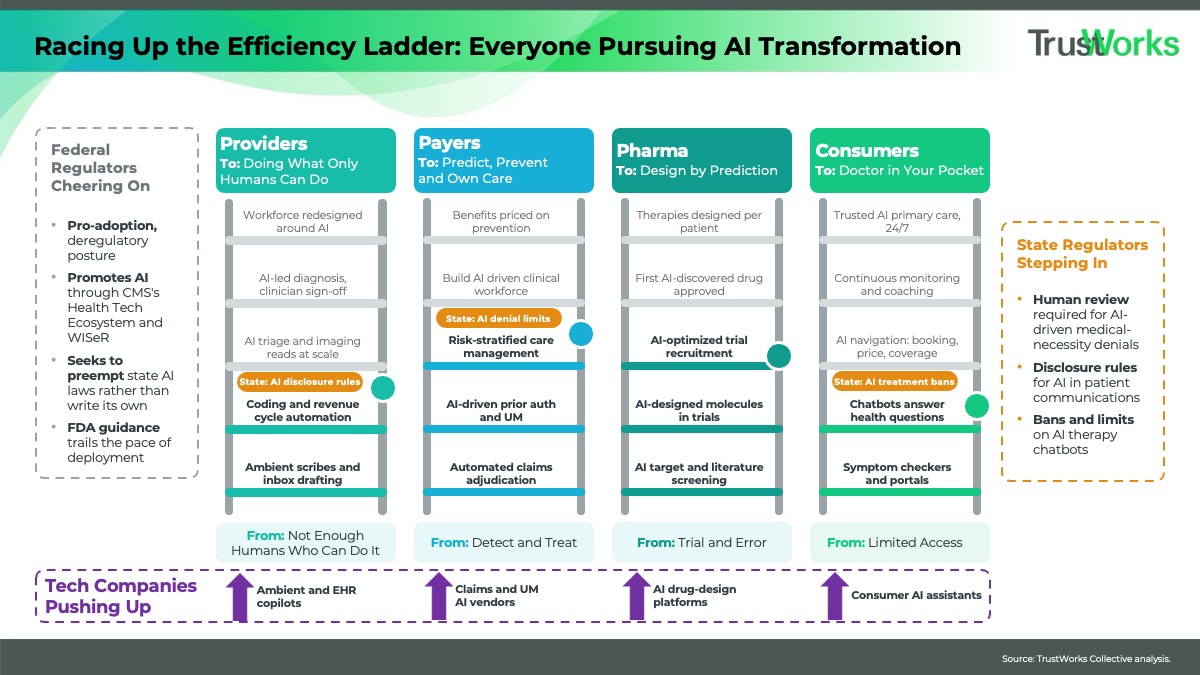
The Many Competitive Dimensions of AI
A June PwC survey found that 70 percent of health plan actuaries rank providers’ AI documentation and coding tools among the top three drivers of rising medical costs, while the share of health systems using at least one AI application jumped from 59 percent to 75 percent in a year. This exemplifies how the AI advancements organizations within each healthcare sector are pursuing—to improve productivity, reduce costs, and gain a competitive advantage—have major implications across sectors. Health systems are competing with consumer-facing diagnostic technologies, while pharma companies are accelerating drug development even as purchasers seek to control spending. Each sector is so focused on its own AI strategy and maximizing its individual value that we are losing the thread on how AI can connect things that are currently siloed. Winning the AI race will require understanding not only how to improve your own performance, but how AI is changing the economics and behavior of everyone around you. |
|
|
Dialing In
Sharing insights from our work with clients
Who Owns the Follow-Up?
During a break between strategy sessions with a primary care group, the subject of Grail’s Galleri test came up. The blood test screens for signals from more than 50 types of cancer and could soon be FDA approved, leading to Medicare coverage, although patients can already pay $949 out-of-pocket for it. There was cautious excitement for Galleri, as most cancers it detects have no recommended screening test, and catching a pancreatic cancer at stage I instead of stage IV could save a life. But one physician was dreading its potential approval. Her patients already bring in results from whole-body MRIs and direct-to-consumer labs she never ordered, and in the data the FDA reviewed, patients whose positive Galleri result turned out to be a false alarm waited a median of 75 days for an answer. A large, randomized trial in England did not reduce late-stage diagnoses overall, and the only evidence we have of it saving lives comes from anecdotal cases.
Nonetheless, an FDA advisory panel backed Galleri in September, and full approval would likely accelerate consumer-initiated testing, with the downstream work landing on primary care. Someone, often a primary care provider who had no involvement in ordering the test, has to be responsible for managing its follow-up, such as interpreting the result, ordering imaging, coordinating referrals, and reassuring a patient whose workup comes back clean. And while the patient could pay out-of-pocket for the test, the follow-up is billed to insurance, and the coordination falls to already stretched practices as unpaid time. Earlier detection and more engaged patients are worthwhile goals, but making information accessible is easier than making it actionable. The jury is still out on whether this test may be creating more healthcare activity without creating better healthcare.
|
|