Bluesday 2026
November 5, 2026
|
|
Welcome to TrustWorks On Call, here with your healthcare business and strategy 411 for the week. If you enjoy our work, please consider forwarding it along to a friend and encouraging them to subscribe.
This week, we go Beyond the Whiteboard to compare more than a decade of health coverage cost growth against wages and other household expenses, before Dialing In on what we told one health system's executive team the morning after the election.
But first, we have to cover a very full week of news, starting with Tuesday’s blue tsunami, which will certainly have ripple effects on health policy. This week was so full, in fact, that you'll have to wait until next week to get the TrustWorks Take on the 2027 Physician Fee Schedule final rule.
|
Behind the Headlines
Unpacking the forces driving healthcare's biggest stories.
|
1. Democrats take House and Senate in wave election.
- Federally, Democrats took control of both chambers of Congress in Tuesday’s election, flipping at least seven Senate seats for a 54-seat majority (with Alaska and Mississippi uncalled), and winning the House handily by flipping at least 29 seats, with dozens of races still uncalled.
- At the state level, Democrats also picked up five governorships to now control 28 states, and flipped one or both chambers of at least seven state legislatures, with the potential to control a majority of the 99 state chambers for the first time since they lost it in 2010.
TrustWorks Take: Had Democrats narrowly taken back the House and Senate as predicted, we would expect a strong oversight agenda and not much else from Congress. Instead, by winning in a historic wave, they can claim a credible mandate to address affordability, with presumptive House Speaker Hakeem Jeffries already pledging to “reverse the Medicaid cuts and extend the Affordable Care Act tax credits.” President Trump, for his part, said, “We’ll work with the Democrats,” but also predicted, “What happens is I veto everything.” The presidential veto power creates a tension between Democrats’ goals of holding Trump accountable and working with him on an affordability agenda, which could become a theme in the (all-too-soon-to-begin) 2028 campaign season.
Our prediction: we see continued progress on bipartisan health issues like pharmacy benefit manager (PBM) reform, price transparency, and information blocking, but the big Democratic healthcare priorities like reversing Medicaid cuts wait until after the 2028 election, although a delay could be on the table in the meantime.
The more immediate impacts of this election should come from state governments. Four of the ten states that have not expanded Medicaid now have a chance to change that. Wisconsin is now under complete Democratic control and very likely to expand Medicaid; in Texas and Georgia, Democrats hold the governorship and state House, but not the Senate; and Kansas now has a Democratic governor working with a Republican legislature, giving it the slimmest odds. New Democratic governors in expansion states like Ohio, Iowa, and also Nevada will run the work requirement rollout, giving them discretion over verification, outreach, and how generously exemptions are applied (relevant to our third story). And more state legislatures may now pursue policies like state-level exchange subsidies to address healthcare affordability. |
|
|
2. CVS to split retail pharmacy from insurance and PBM business.
- CVS Health announced it will split into two publicly traded companies by the first half of 2028: CVS Health, led by CEO David Joyner, will keep Aetna, Caremark, Oak Street Health, Signify Health, and the specialty pharmacy business; CVS Pharmacy, led by Prem Shah, will take the roughly 9,000 retail stores, mail order business, and walk-in clinics.
- The news came alongside a strong quarter: $2.2B of profit on $108.4B of revenue, compared to a $4B loss a year earlier, but shares still fell about 10 percent.
TrustWorks Take: This decision by CVS was a long time coming. When CVS bought Aetna for roughly $70B in 2018, the pitch was that thousands of storefronts would become community health destinations, steering Aetna members toward lower-cost care around the corner, but that model never materialized. CVS closed about 900 stores between 2022 and 2024 and quietly moved on from its in-store HealthHUBs, while profits kept coming from where they always had: Caremark and Aetna. In practice, CVS integrated its corporate structure far more than its care model, and the resulting conglomerate made each business harder to value and raise capital for. Vertical integration offers so much potential value, but CVS is only the latest example of how hard it can be to realize that value.
Joyner insists regulators are not the reason for this split, but new laws in Arkansas and Tennessee seek to bar common ownership of pharmacies and PBMs, a policy more states are considering and a bipartisan federal bill would do the same nationally. The split separates precisely those two businesses, the PBM and the drugstores, while keeping the insurer, the PBM, and the Oak Street and Signify care delivery assets under one roof. For health systems, the competitive threat was always the payer-PBM-primary care combination, which stays intact. However, this is also the structure lawmakers in both parties are still circling, with this wave election potentially providing wind in the sails for PBM reform and more antitrust scrutiny. |
|
|
3. District judge blocks Medicaid medical frailty rule.
- A district court judge in Massachusetts ruled against the requirement from the Centers for Medicare and Medicaid Services (CMS) that medically frail Medicaid enrollees must prove their condition limits their ability to work, after more than two dozen states and D.C. had sued over the June interim final rule.
- The judge upheld two other contested provisions: a 12-month limit on the claims data states can use to identify frail enrollees, and limits on how often enrollees can self-attest starting in 2028.
- States that sued get six months before frailty-based disenrollments can proceed, but otherwise work requirements still take effect January 1 for most expansion adults ages 19 to 64.
|
TrustWorks Take: The stringency of CMS’s frailty test caught states and providers by surprise when it arrived in June, so provider groups are celebrating this as a victory. By restoring the statute’s simpler test, the ruling should lead to fewer eligible people losing coverage over paperwork. However, it means more chaos in the short term. States, already behind on building eligibility systems for a January 1 launch, now must rework frailty verification weeks before go-live without knowing whether CMS will appeal. KFF expects many states to hold off on system changes until the decision is settled, and at least eight states plan to require frailty documentation rather than accept self-attestation for 2027. Meanwhile, the upheld 12-month claims lookback means a state’s view of who is frail is only as good as what was recently billed. The enrollees most at risk are those with a qualifying condition and no recent visit. That makes documenting qualifying diagnoses for Medicaid patients as important for patient coverage retention as for provider revenue. |
|
|
Beyond the Whiteboard
Visualizing key trends from the healthcare industry

|
Healthcare Inflation is Worse Than You Think
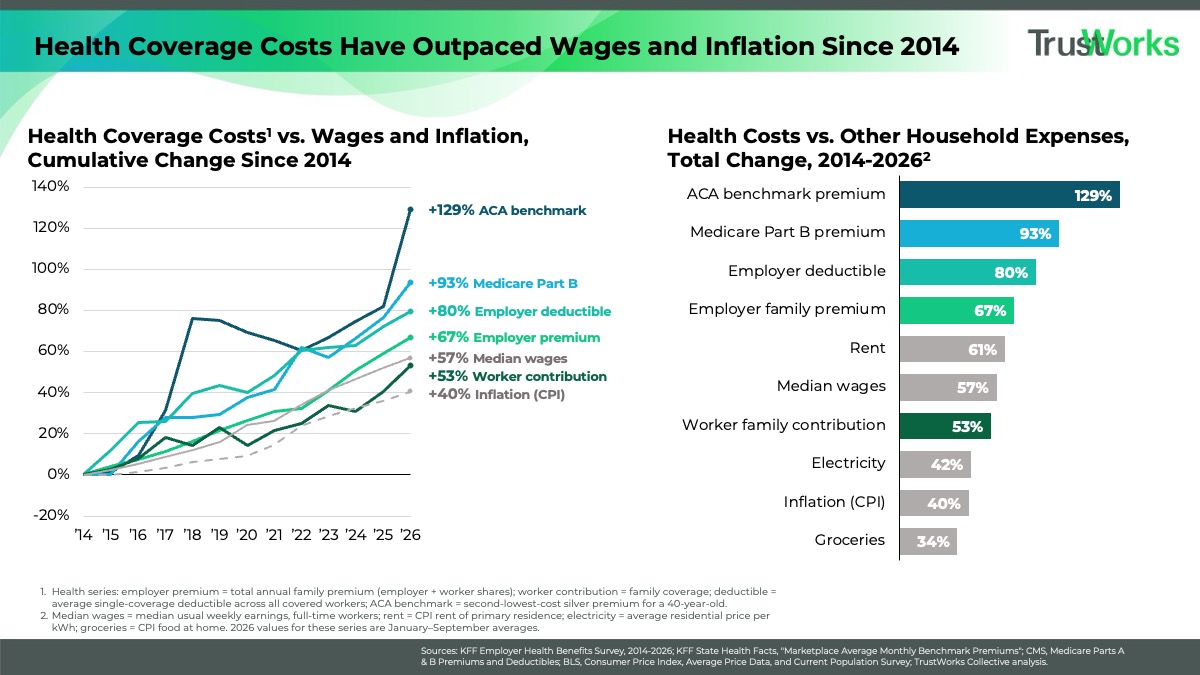
Every fall brings a fresh round of headlines about rising insurance premiums, and this year is no exception: benchmark ACA premiums are increasing 13 percent for 2027 after a 26 percent jump in 2026, and premiums for stand-alone Part D drug plans could jump 50 percent. But these single-year increases may undersell the cumulative effect of how persistently healthcare costs have outpaced household income and other expenses. Since 2014, the sticker price of an ACA benchmark plan has risen 129 percent, Medicare Part B premiums 93 percent, and the average employer deductible 80 percent. Over the same period, median wages grew 57 percent and overall inflation 40 percent. Healthcare premiums and deductibles also grew faster than household essentials like rent (61 percent), electricity (42 percent), and groceries (34 percent).
If Congress gets serious about addressing affordability, it may want to start with healthcare, arguably the average American household’s biggest concern. Addressing it requires going beyond insurance coverage because households and employers cannot keep up with the underlying costs of care. Extending subsidies may provide necessary relief, but subsidies redistribute the financial burden without necessarily addressing its underlying drivers. Until policymakers confront those drivers, affordability will remain an increasingly expensive problem to manage.
|
|
|
Dialing In
Sharing insights from our work with clients
Even These Election Results Do Not Change Healthcare’s Math
On Wednesday morning, with the House and Senate called, we were onsite with the executive team of a regional Midwestern health system. As we watched the latest round of pundit takes over breakfast, we had to decide what we would say about the night before. The results opened up more paths toward revenue relief valves—perhaps we see a partial ACA subsidy, or some Medicaid cuts get delayed—but hospitals could still end up paying in other ways, if for example Congress offsets that relief with site-neutral payment reform, which has bipartisan support. Wall Street’s reactions indicated optimism for health systems, but that may turn out to be more of an electoral sugar high.
Underneath the policy noise, the business model challenges are the same as they were on Monday. The economy will not rebound overnight. The commercial cross-subsidy that has long sustained hospitals keeps decaying, with employers and households more constrained by healthcare spending than ever. Nothing on Tuesday’s ballot reverses those trends, so the priorities health systems have set should remain unchanged: treat costs as a crisis, move care to lower-cost settings ahead of site-neutral payment, prepare Medicaid patients for work requirements, and negotiate with payers as if commercial rate growth will slow. The election changed who will hold the hearings. It did not change the underlying math or finances of healthcare delivery, which is where leadership attention must remain.
|
|