Payer Party
October 15, 2026
|
|
Welcome to TrustWorks On Call, here with your healthcare business and strategy 411 for the week. If you enjoy our work, please consider forwarding it along to a friend and encouraging them to subscribe.
This week, we go Beyond the Whiteboard to see how the largest health systems fared in the first half of 2026, before Dialing In on what healthcare’s iPad moment might look like. But first the news, where payers were the life of a not-very-fun party, starting with the latest Medicare Advantage star ratings.
|
Behind the Headlines
Unpacking the forces driving healthcare's biggest stories.
|
1. CMS releases MA star ratings—and gets sued again.
- The Centers for Medicare and Medicaid Services (CMS) released the 2027 Medicare Advantage (MA) plan star ratings, which measure a plan’s quality and help determine its payment, with a mild drop in net average—from 4.01 to 3.99—masking more churn below the surface.
- Of the ten largest MA insurers, Humana, Blue Cross Blue Shield of Michigan, and Devoted Health will improve their share of members in plans rated four stars or higher next year (led by Humana jumping from 41 to 93 percent), while UnitedHealthcare, CVS, Elevance, Centene, and Health Care Service Corporation will have fewer.
- Alignment Healthcare sued CMS after the share of its members in four-star plans fell from 98 percent to 25 percent, a drop Alignment says will cost the company more than $200M in 2028, arguing that CMS used measures never adopted through formal rulemaking.
TrustWorks Take: MAMA payers have spent two years trading enrollment for margin, and stars are a big part of the math: quality bonuses totaled $13.4B this year, more than four times their 2015 level; average bonus payments for special needs plans increased from $85 to $318 over that time. Payers prioritize enrollment in four-star plans because they get a 5 percent benchmark boost and keep more savings for extra benefits, with this fall’s ratings determining 2028 payments. Humana emerges as a winner after spending years climbing back above four stars, which TD Cowen estimates is worth more than $3B in 2028 revenue, while UnitedHealthcare’s president admitted they “knew there could be some stars pressure” after pulling back on plan offerings. About half of MA plan leaders say their core medical benefits will be less generous in 2027, so payers cutting benefits to protect this year’s margin may be giving up the bonus dollars that fund future benefits and profits.
For CMS, the larger problem is that star ratings are increasingly decided in court. Clover Health’s successful lawsuit this spring, which CMS has appealed, forced CMS to recalculate 2026 ratings for every plan, and Alignment and two other plans are already suing over their 2026 scores. Each recalculation undermines the credibility of the program and empowers the bipartisan chorus of critics who want to overhaul or eliminate quality bonuses. A University of Michigan study found no significant improvement in plan quality attributed to the bonus program, and the Medicare Payment Advisory Commission (MedPAC) has long recommended replacing it with a budget-neutral value incentive program. |
|
|
2. BlackRock buys out Welsh Carson in $2.8B Humana primary care joint venture.
- On Tuesday, Humana announced that BlackRock, through its investment arm HPS, will buy out private equity (PE) firm Welsh, Carson, Anderson & Stowe’s $2.8B stake in nearly 150 CenterWell senior primary care clinics, becoming majority owner of a new joint venture.
- CenterWell will remain a minority owner and keep running the clinics, while BlackRock plans to fund their growth over the next two years, including building new clinics and pursuing acquisitions.
- The deal eliminates a “put option” that could have required Humana to buy back Welsh Carson’s stake starting in 2030; instead, CenterWell can buy clinics back starting in 2028, and BlackRock can sell any clinics remaining after 2033, with CenterWell getting the first offer.
TrustWorks Take: Humana keeps running its clinics while restructuring its future capital obligations by swapping a mandatory buyback with Welsh Carson for an optional one with BlackRock. BlackRock, in turn, gets a maturing asset and a built-in buyer for its exit. CenterWell grew its patient base by over 25 percent last year to reach 500K, a pace Humana hopes to maintain this year as it expands its footprint of clinics. The strategy is to tie this growth to Humana’s MA enrollment footprint and capture more of the premium dollar. Humana is already doing a good job of this, given that 80 percent of CenterWell’s revenue comes from serving Humana patients.
Welsh Carson’s exit is also a sign of how it has become harder for PE firms to find buyers for their healthcare platforms. PE takeovers of physician groups fell from 851 in 2021 to 105 in the first half of 2026, and senior primary care has lost its luster since Cano Health’s bankruptcy and Walgreens’ multibillion-dollar VillageMD write-downs. Welsh Carson had a contractual exit to a strategic buyer in Humana, and it still ended up selling to another financial investor. PE firms rolling up physician practices without a payer partner waiting at the end should expect longer holds and more sales to other investors..
|
|
|
3. UHG beats expectations thanks to Optum and market retreat.
- On Tuesday, UnitedHealth Group (UHG) beat expectations in Q3 with adjusted earnings of $4.69 per share, ahead of the $4.12 analysts predicted, and raised its 2026 outlook for the third time this year to at least $20.50 per share.
- Optum Health’s operating margin rose to 3.2 percent from 0.2 percent a year earlier, even as its revenue fell 10 percent, while UHG’s total revenue slipped slightly to $112.7B.
- The company’s medical loss ratio across all books fell to 88.4 percent from 89.9 percent as UHG shed about 935,000 MA members since the end of 2025 and, for 2027, cut hundreds of plans, trimmed benefits, and shifted toward narrower networks and special needs plans.
TrustWorks Take: UHG’s turnaround strategy is paying off, but mostly by getting its affairs in order through financial and operational discipline. Optum Health profits rose as its revenues shrank, and UnitedHealthcare insurance margins recovered by dropping members and benefits, with help from $610M in favorable reserve adjustments. These are cost cuts and portfolio pruning, not the long-promised payoff of stitching UHG’s insurer, physicians, pharmacy, and data businesses into a cohesive system.
Consumers are paying for the recovery: across the market, more than 3M seniors face MA plan terminations or county exits for 2027, and many who stay will see narrower networks and higher cost-sharing. When the largest MA insurer improves its margins by covering fewer people with less generous benefits, the burden shifts to seniors and providers. Health systems should expect the same discipline in UHG’s rate negotiations next year. |
|
|
Beyond the Whiteboard
Visualizing key trends from the healthcare industry

|
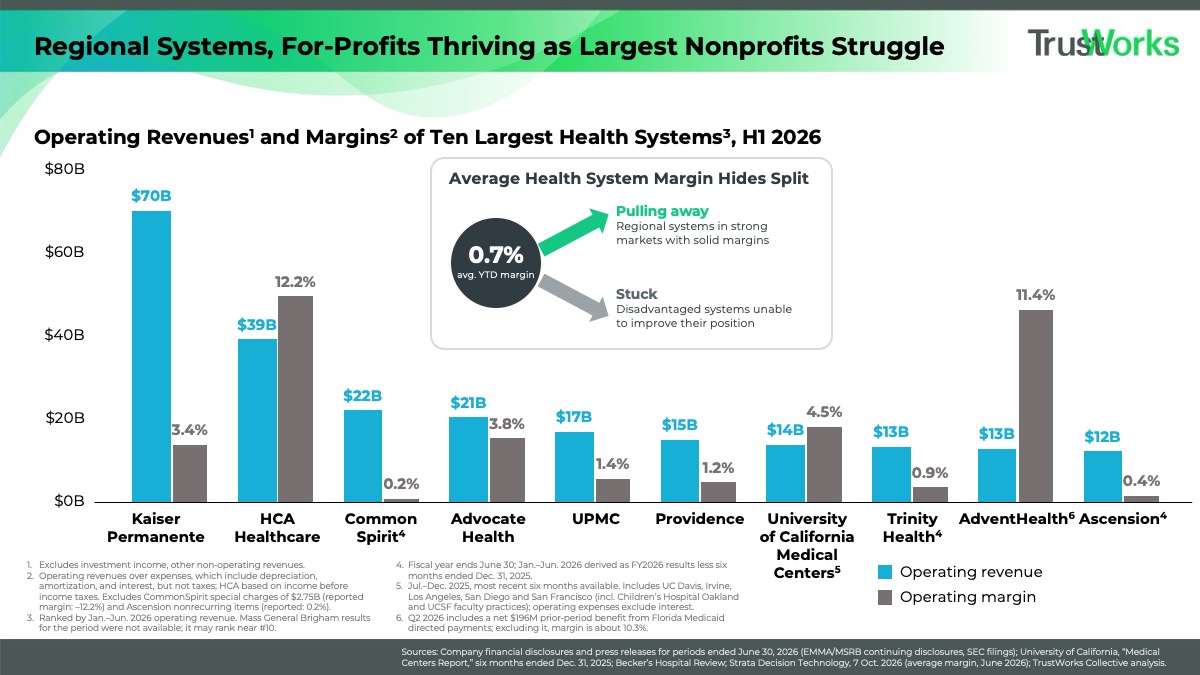
How the Largest Health Systems Fared in H1 2026
The median health system operating margin was just 0.7 percent as of June, but that thin measure hides a widening split. Among the largest systems by revenue, HCA Healthcare (12.2 percent) and AdventHealth (11.4 percent) posted double-digit operating margins in the first half of 2026, followed at a distance by Advocate Health (3.8 percent) and Kaiser Permanente (3.4 percent). At the other end, the multistate Catholic systems—CommonSpirit, Ascension, Trinity Health, and Providence—posted margins between 0.2 and 1.2 percent (CommonSpirit’s figure excludes $2.75B in special charges).
When we ran this analysis last year, four of the largest nonprofits lost money on operations in 2024. Setting aside CommonSpirit’s charges, none are in the red this time, but few generated a comfortable margin. Scale alone is not buying margin. The systems pulling away tend to combine cost discipline with concentrated positions in strong markets, like AdventHealth in Florida (although a one-time $196M Medicaid payment boosted its results). The “stuck” systems sprawl across markets where they rarely dominate; being big is not the same as being dominant or integrated. Industry averages can be deceiving: a 0.7 percent median papers over a few systems pulling away—and many more stuck in place.
|
|
|
Dialing In
Sharing insights from our work with clients
Searching for Healthcare’s iPad Moment
“Can I book an appointment with my doctor on my phone in under two minutes?” A health system executive asked this at the end of a strategy work group meeting, after an hour of pitches for an AI symptom checker, a wearable integration, and a virtual nursing pilot. The answer was no, and it was not clear how any of the pitches would bring it closer to yes. Within the world of AI-powered everything, what will actually break through as a meaningful change for consumers? Much of what gets labeled innovation seems more like repackaging existing services or layering new technology onto traditional delivery models.
A better model for real innovation is the iPad. Apple did not invent touchscreens, mobile computing, or internet access. It put existing capabilities together so well that consumers embraced something they did not know they wanted. Health systems experimenting with AI and wearables is fine, but wearable data is unlikely to improve outcomes at scale yet. The innovation consumers want, and the kind that will bring growth, is fixing the transactional and process problems they run into every day. When health systems cannot reliably schedule an appointment, coordinate a referral, or explain a bill, adding more technology puts the cart before the horse. Innovation should be judged by whether it solves a meaningful problem, creates demonstrable value, and changes behavior, not by how sophisticated the technology appears. The next great healthcare innovation may simply make the things patients already need work so well that they cannot imagine going back.
|
|