Put a Ring on It
November 13, 2026
|
|
Welcome to TrustWorks On Call, here with your healthcare business and strategy 411 for the week. If you enjoy our work, please consider forwarding it along to a friend and encouraging them to subscribe.
Apologies for the delayed edition, it has been a difficult 24 hours for the email business. We hope that your Outlook inboxes are back up and running now, and that the Outage was more inconvenient than disastrous for you.
This week, we go Beyond the Whiteboard to map where big tech, Epic, and startups are competing in healthcare AI, before Dialing In on why technology is the easy part of rural telehealth. But first the news, starting with two big CMS final rules dropping, before getting to Oura making it official with its primary care match.
|
Behind the Headlines
Unpacking the forces driving healthcare's biggest stories.
|
1. 2027 PFS and OPPS rules target efficiency and fraud.
- The Centers for Medicare and Medicaid Services (CMS) published the 2027 Physician Fee Schedule (PFS) Final Rule on November 4, which cut the conversion factor 2.31 percent for clinicians outside advanced alternative payment models (APMs) and 1.83 percent for those in them.
- The PFS also finalized a policy to pay for remote patient monitoring (RPM) only when the billing practice employs the staff providing it, but it delayed the start from 2027 to 2029.
- On the same day, CMS issued the 2027 Hospital Outpatient Prospective Payment System (OPPS) Final Rule, which raises outpatient payments 2.3 percent, but cuts payment for 340B drugs from average sales price (ASP) plus 6 percent to ASP minus 28 percent.
- The OPPS rule also extends site-neutral payment to imaging without contrast at off-campus hospital outpatient departments (HOPDs), worth about $260M in 2027 savings, and removes 637 more procedures, including some maternity care and delivery services, from the inpatient-only list.
TrustWorks Take: These two rules fit clearly within the Trump administration’s approach to lowering healthcare spending. They see it as wasteful to pay hospitals more for care performed at HOPDs, or to pay full price for drugs hospitals get at 340B discounts. They also view third-party RPM services as so rife with fraud that they are willing to stop paying for RPM delivered by contracted staff, although providers and RPM vendors hope the delay provides an opportunity to negotiate a middle ground. Health systems can defend their reliance on 340B and elevated HOPD rates as essential to maintaining their margin, but they should expect regulators to keep chipping away at them one “pocket of profitability” at a time.
Of course, a final rule from CMS is never truly final. The 2.31 percent conversion factor cut to physician payment is a result of a one-time 2.5 percent boost from Congress expiring, and physicians will lobby for a reprieve yet again during the lame-duck session. Ending third-party RPM Medicare billing altogether is an extreme step, even if the government has found credible accounts of fraud, and so a sympathetic Congress could attach restoring third-party RPM billing, perhaps with new guardrails, to the extension of Medicare telehealth flexibilities, which expire at the end of 2027. CMS also left the door open, saying it may clarify before 2029 whether leased or contracted staff can qualify, and vendors are lobbying for standards that would let vetted partners keep billing. In the meantime, health systems should not count on Congress or CMS to resolve this for them; they should plan to bring RPM in-house while making sure any vendor they keep could meet tougher standards.
|
|
|
2. Oura to acquire virtual primary care platform Counsel Health.
- Smart-ring maker Oura announced on Tuesday a $625M deal to acquire Counsel Health, an AI-first primary care service that employs physicians to diagnose, prescribe, and refer.
- The companies have partnered since May, embedding Counsel in the Oura app and joining CMS’s ACCESS model that provides tech-enabled chronic care to Medicare beneficiaries.
- Oura, which has about 6M paid members, reported fiscal 2026 revenue of about $1.75B, up 92 percent, after postponing a planned $2.1B IPO in September.
TrustWorks Take: Oura has walked a regulatory tightrope by marketing its ring largely as a “wellness” product, rather than a “medical device,” which would warrant stricter Food and Drug Administration regulation. By acquiring a primary care “front door” in Counsel Health, Oura can expand into AI-enabled healthcare delivery without drawing extra regulatory scrutiny for its ring, although it now takes on the licensing, malpractice, and prescribing obligations that come with practicing medicine. Since primary care itself is not all that lucrative, especially without risk or downstream referrals, Oura must have some synergies in mind that will drive more subscriptions. Counsel’s general offering, a $159 annual add-on to an Oura subscription, is pitched as on-demand care for everyday needs, not a replacement for a regular physician. This limits its market to being largely a convenience purchase for customers who already have a doctor.
The more promising business is cash-pay prescribing, the playbook Hims & Hers and Ro built on hair loss, erectile dysfunction, and skin care before pivoting hard to GLP-1s. Counsel’s weight management program charges $300 a year (or $29 a visit) and prescribes Zepbound, Wegovy, and Lilly’s oral Foundayo. More than 100K Oura members have already logged GLP-1 use, and a ring that tracks weight, sleep, and heart rate is an effective tool for keeping a patient on a monthly prescription. Moreover, Eli Lilly owns a piece of Oura, and Counsel is a provider option on Lilly’s direct-to-consumer pharmacy, LillyDirect. Oura claims it postponed its IPO due to market conditions, but when it eventually goes public, investors will reward it for growing higher-margin subscription services as a supplement to the hardware, especially if it can become a go-to platform for its users to purchase healthcare services. |
|
|
3. Two high-profile heart drugs fail, surprising researchers.
- Highly anticipated full results presented last week at the American Heart Association’s annual meeting showed that Novartis’ pelacarsen and Novo Nordisk’s ziltivekimab were no better than placebo at preventing heart attacks, strokes, or deaths, in any patient subgroup.
- Pelacarsen cut Lp(a), a genetically driven cholesterol particle, by 78 percent in the 8,300-patient HORIZON trial. Ziltivekimab, which blocks the inflammatory protein IL-6, reduced inflammation in the 6,376-patient ZEUS trial. Both trials enrolled patients with established heart disease.
TrustWorks Take: The striking thing about these failures is how well the drugs worked. Both rested on widely held theories of what drives heart attacks beyond LDL cholesterol: that Lp(a) particles promote the clots that block arteries, and that inflammation inside arterial plaque causes it to rupture. Pelacarsen drove Lp(a) down by more than three-quarters, and ziltivekimab suppressed inflammation as designed. Despite this, neither moved the outcomes that matter. The ZEUS result in particular challenges an inflammation hypothesis that has shaped cardiology for a quarter century, leaving some cardiologists to wonder whether inflammation is a marker of heart disease rather than a cause.
Neither drug was discovered by AI, but their failures are a useful check on the hype around AI drug discovery. AI’s clearest gains so far have come in designing and refining molecules, the step these companies got right. A 2024 analysis by BCG and the Wellcome Trust found that AI-discovered drugs pass Phase 1 safety trials 80 to 90 percent of the time, well above historical rates, but succeed in Phase 2 only about 40 percent of the time, roughly in line with the industry. These expensive, late-stage trial failures happen when a well-designed drug meets the complexities human biology, and both Lp(a) and IL-6 came with exactly the kind of genetic evidence that AI target-selection tools prize. AI can design a molecule that hits its target; it cannot yet tell you whether the target was worth hitting.
|
|
|
Beyond the Whiteboard
Visualizing key trends from the healthcare industry

|
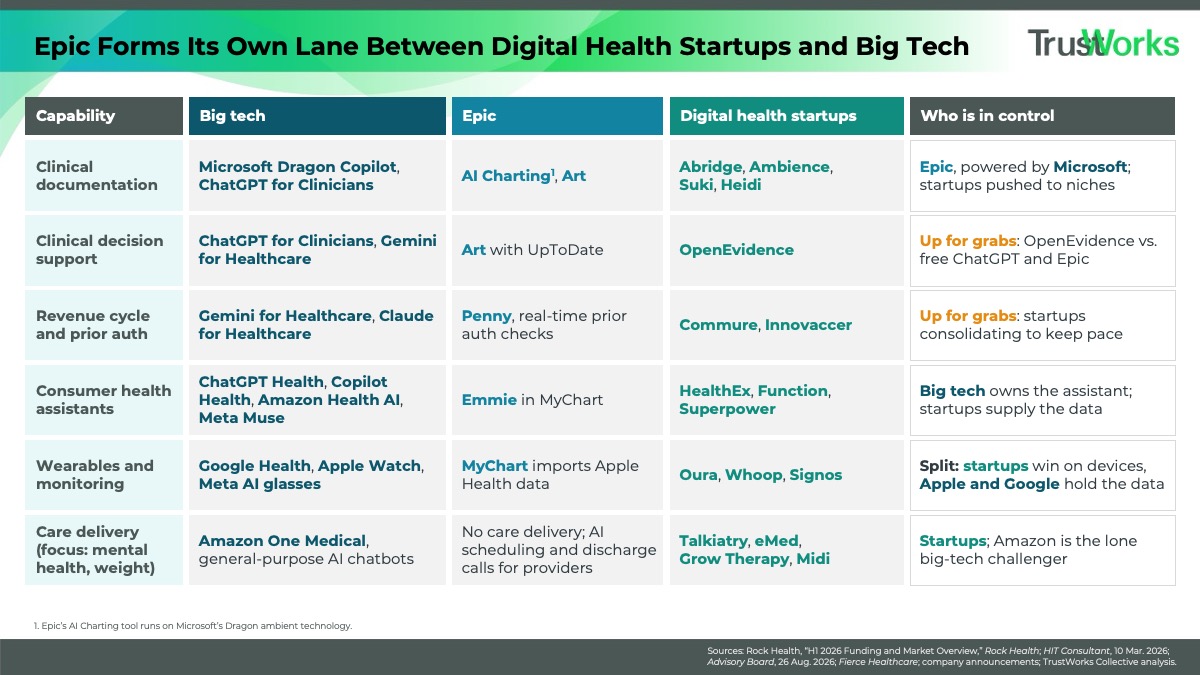
Big Tech, Epic Crowding Out Digital Health Startups
This week, Google announced Gemini for Healthcare, a Google Cloud product for health systems and insurers that summarizes patient records from Epic and other systems, prepares prior authorizations, and estimates patient costs. It joins a crowded field, as every major technology company now offers healthcare AI, from OpenAI’s ChatGPT for Healthcare and Anthropic’s Claude for Healthcare to Microsoft’s Dragon Copilot, which more than 100K clinicians use daily. Big tech now competes with digital health startups in nearly every domain: clinical documentation, decision support, revenue cycle, and consumer health assistants. Care delivery remains the notable exception, where startups such as Talkiatry, eMed, and Midi continue to build businesses around mental health and weight management, and Amazon One Medical is the lone big-tech challenger.
Then there’s Epic, which has carved out its own lane in the middle, relying on big tech while building capabilities that challenge established digital health startups. Its AI Charting tool runs on Microsoft’s Dragon technology and launched the day after Abridge topped the KLAS rankings for ambient scribes, while its billing assistant, Penny, and its MyChart assistant, Emmie, target other strongholds for startups. For health systems, the safest AI bet is often the one already inside the EHR, which promises fewer vendors, tighter integration, and lower costs. That appeal has a growing number of systems describing themselves as “Epic-first.” Epic’s dominance also draws scrutiny: a STAT investigation found that Epic, now in 55 percent of U.S. inpatient beds, limits data access for rival apps, and the FTC is reviewing its practices.
|
|
|
Dialing In
Sharing insights from our work with clients
For Telehealth, Technology Is the Easy Part
“We need a telehealth platform that can connect our rural hospitals with specialists across the system.” So began a recent conversation with a health system client. The system is using part of its state’s Rural Health Transformation Program funding (CMS just announced a second year of awards) to expand specialty access at its rural hospitals. Within minutes, the discussion turned to carts, cameras, bandwidth, and vendors. All of it matters, but these purchasing decisions are the easy part. The harder work is building an operating model that makes telehealth clinically effective, financially sustainable, and workable for the people expected to use it.
Consider a rural emergency department that needs a neurology consult. The video link connects in seconds; the neurologist on the other end may already be covering two other emergency departments. The rural hospital may lack the staff, medications, or confidence to carry out a remote recommendation, which can push the case toward the very transfer the consult was meant to avoid. Privileges, liability, and payer enrollment all need to be settled, and so do the economics: who keeps the professional and facility revenue, and how specialists are paid for being available rather than only for billable consults. Multiply that by every specialty in the program, each with its own coverage, workflows, and math, and a better camera solves none of it. Grant dollars are well suited to buying equipment and poorly suited to paying for specialist call coverage in year four. A program built around the technology will last about as long as the grant that funds it, whereas one built around the operating model has a chance to outlast it.
|
|