Not Not a Healthcare Election
October 29, 2026
|
|
Welcome to TrustWorks On Call, here with your healthcare business and strategy 411 for the week. If you enjoy our work, please consider forwarding it along to a friend and encouraging them to subscribe.
In this week’s midterm election edition, we go Beyond the Whiteboard to explain why the record popularity of Medicare for All says more about voter frustration than about the next Congress, before Dialing In with Maverick Health Policy’s Julie Barnes on why health tech policy will remain a hot topic in Washington, regardless of this Tuesday’s results. But first the news, starting with why healthcare will be on voters’ minds this Election Day, even if the results are unlikely to lead to meaningful reforms.
|
Behind the Headlines
Unpacking the forces driving healthcare's biggest stories.
|
1. Midterm voters highly motivated by healthcare, cost of living.
- In a KFF survey from September, 63 percent of Democratic voters said they are “more motivated” than usual to vote this year, compared to only 38 percent of Republican voters, with healthcare costs tying gas prices for voters’ top financial concern.
- In another survey from Pew Research Center, only the economy (84 percent) and the future of democracy (73 percent) ranked higher than healthcare (68 percent) as a very important issue for voters, though Democratic supporters (82 percent) were far more likely than Republican supporters (53 percent) to say so.
TrustWorks Take: This is not a healthcare election in the sense that candidates are running on detailed or realistic healthcare proposals, but healthcare is still a top three concern on voters’ minds. As KFF’s Drew Altman puts it, the issue that matters most is the cost of living, and healthcare is a central part of that. Voters are reacting both to costs Congress directly controls, like the expiration of enhanced ACA subsidies, and to costs it controls far less, like the cost of employer coverage. Democrats have widened their trust advantage on healthcare costs from 11 to 20 points since April, while Republicans have focused their pitch on rooting out fraud in government programs.
Regardless of Tuesday's outcome, meaningful healthcare reform appears highly unlikely over the next two years. Poll watchers are predicting Democrats to flip the House at least, producing a divided government that would grind legislative action to a halt. The more consequential question is what happens in 2028, with Democrats likely campaigning on expanded coverage and Republicans needing to articulate a more comprehensive alternative. Neither party has demonstrated how it intends to meaningfully reduce healthcare spending without confronting the underlying economics of the system.
|
|
|
2. Average family premiums hit $28K in 2026.
- KFF found that average annual premiums for family coverage reached $28,303 in 2026, up 5 percent from 2025, with employers contributing $20,833 and workers $7,471.
- Worker contributions rose 9 percent, outpacing both wage growth (3.7 percent) and inflation (2.7 percent). Since 2021, family premiums have grown 28 percent, slightly ahead of wages (27 percent) and inflation (24 percent).
- Employer benefit surveys are also predicting healthcare costs to rise by another 10 percent or more in 2027.
TrustWorks Take: Employer-sponsored plans are the primary source of healthcare coverage, so when voters say they are fed up with rising healthcare costs, this is usually what they are talking about. Affordable Care Act, Medicare, and Medicaid plans, which are also getting more expensive, receive more political attention because Congress has more direct power over them, but voters do not necessarily recognize that distinction. When a majority of Americans say they put the responsibility for making care affordable on Congress and the president, they expect reforms that impact employer-sponsored plans too. Employers, too, might be reaching their breaking points, with 44 percent of large firms raising workers’ share of premiums this year, and their adoption rate of ICHRAs doubling year-over-year.
Congress and the Trump administration have pushed tools like price transparency that should help on the margin, but there is only so much negotiating can accomplish in consolidated markets. Meaningfully reducing costs ultimately requires confronting what we pay for care, how much care we consume, and whether that care delivers value. Those are considerably more difficult conversations, particularly when one stakeholder's savings often represent another's lost revenue. Neither national party appears particularly eager to have these conversations, but states are proving bolder, such as Indiana implementing commercial price caps for hospitals. |
|
|
3. Uninsured rate climbs to 11 percent.
- According to the Commonwealth Fund’s 2026 Biennial Health Insurance Survey, 11 percent of working-age adults were uninsured this year, 12 percent experienced a coverage gap, and 23 percent were underinsured, meaning their out-of-pocket costs or deductibles were high relative to their income; only 54 percent were adequately insured all year.
- The uninsured rate is up from 8.9 percent in 2024, and 50 percent of working-age adults went without needed care because of cost, up from 46 percent in 2022.
TrustWorks Take: After cutting the uninsured rate from 20 percent in 2010 to an all-time low of 8.9 percent in 2024, we are now in the midst of a rebound. With Medicaid work requirements taking effect January 1 (although some states are struggling to meet federal timelines), larger coverage losses are still ahead. Expect it to last the rest of the decade, unless Congress intervenes again.
The uninsured rate is also not a complete picture, as another 35 percent of working-age adults experienced a coverage gap or were underinsured. There is little practical difference between being uninsured and having a plan one cannot afford to use. Either way, care gets delayed, and the unpaid bills land on hospitals, especially safety-net and rural facilities. That raises a question likely to resurface in 2028: could providers eventually find broader coverage at lower rates preferable to a growing population of uninsured and underinsured patients? Rising uncompensated care makes the trade less unthinkable than it once was, though the fight over rates would be fierce. |
|
|
Beyond the Whiteboard
Visualizing key trends from the healthcare industry

|
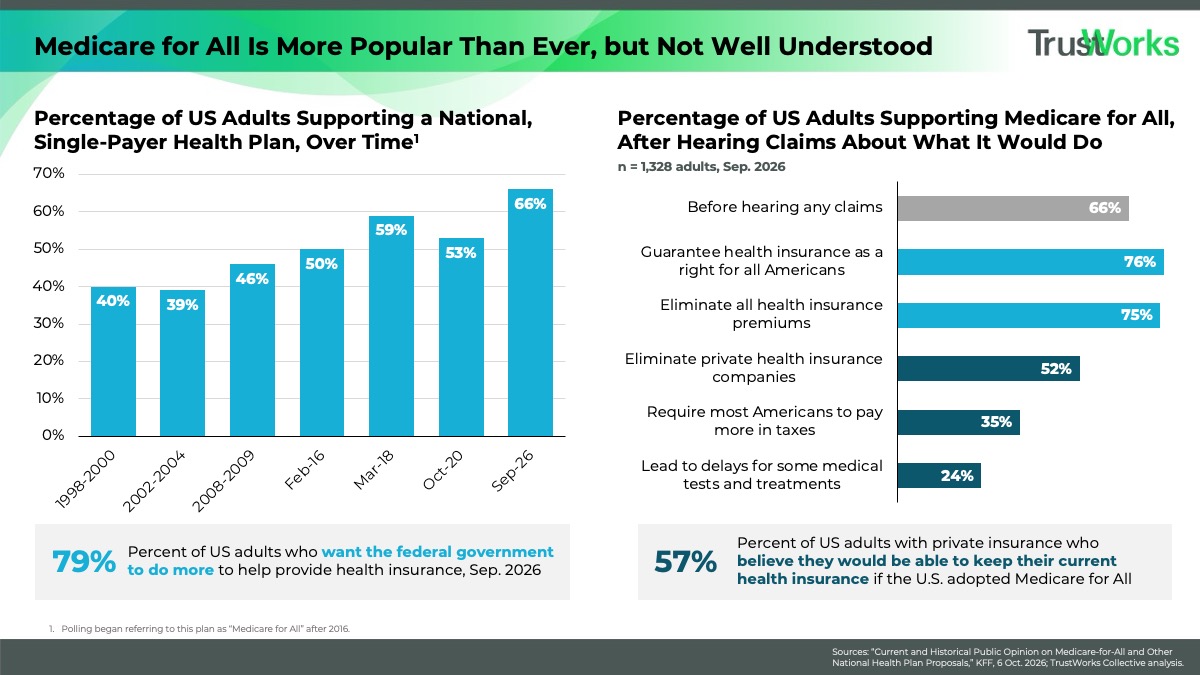
Medicare for All as a Bellwether
Medicare for All is back in the conversation, pushed by progressive Democratic candidates, and gaining popularity: 66 percent of adults now favor it, up from 53 percent in 2020, including a third of Republicans. But that support is malleable. It climbs to three-quarters when people hear it would guarantee coverage or eliminate premiums, and falls to about one in four when they hear it could delay care. And 57 percent of privately insured adults believe they could keep their current plan, which most proposals would not allow. Voters also lack a consistent definition; for many, it simply means a bigger government role in healthcare, which 79 percent support.
Medicare for All is unlikely to become law anytime soon. More incremental expansions of Medicare or Medicare Advantage are more plausible politically, although hardly assured. But its growing popularity tells us something important: Americans are increasingly dissatisfied with what they pay for healthcare and what they receive in return. That frustration may prove more politically consequential than support for any particular reform proposal. |
|
|
Dialing In
Sharing insights from our work with clients
Three Questions on Health Policy with Julie Barnes
Julie Barnes is the founder and CEO of Maverick Health Policy, a DC-based health tech consultancy that unites the policy, tech, and healthcare worlds, with its own weekly blog worth checking out.
1. What role do you see healthcare playing in this election?
In any midterm election year, economic costs and pocketbook issues are at the top of the list for American voters. This year, healthcare and gasoline are the two biggest concerns, so healthcare issues loom large, especially around affordability, health insurance, and how much medical care is costing people.
For those of us in healthcare consulting, the question is, if Democrats take one or both chambers of Congress, what does that mean for health policy priorities. Divided government is what we’re accustomed to, so a change in party control of the legislative branch isn’t that interesting on its own. What’s interesting is that the executive branch will continue on, with a possible slowdown as a new Democratic majority oversees its operations.
2. What would that mean for the health tech issues you work on?
There is true bipartisan interest in health information flowing better and modern technology working better for better outcomes, so we don’t expect much change in what’s important to most stakeholders.
Health plans will continue to implement electronic health record APIs [applied programming interfaces, which allow software programs to talk] for interoperability, with a big deadline coming up January 1st. Patients should still expect a CMS that promises them apps on Medicare.gov and a national provider directory, and HHS leaders very much want to reorient the system, so patients have more opportunities to take care of themselves at home, with wearables and less traditional medical care.
Providers will still be handling the cultural shift from traditional clinical visits to a much greater emphasis on AI in clinical settings, along with other technology. There’s a part of the federal government working to make sure MRIs and X-rays are part of the electronic health records, so we can finally be done with taking CDs to the doctor’s office.
3. What health policy action can we expect from Congress and the executive branch over the next two years?
From Congress, we can expect a lot of noise and not a lot of action. Neither side of the aisle has the power to pass much legislation beyond bites around the edges of existing law, like extending provisions that are sunsetting. I don’t expect to see any large, sweeping healthcare legislation for the next couple of years.
The executive branch, on the other hand, wants to operate at the speed of a bullet train, because it believes it has a very short time to accomplish what it started. Cost efficiency is priority number one, and everything under that for HHS is about how to reduce costs in the healthcare system.
Their main approach, something they call “data liquidity,” is making sure health information is available to whoever needs it to make better decisions at every level. Electronic prior authorization is one example: instead of manual paper pushing, computers should talk to computers to automatically approve or deny requests, taking decisions from a week or more to almost real time. That’s both a cost efficiency and a patient outcome improvement.
Second, they’re being very aggressive about waste, fraud and abuse. One example is applying prior authorization to traditional Medicare through CMMI’s WISeR model, which selectively reviews certain low-value services to decide whether they should be approved. Another is applying artificial intelligence to various parts of the healthcare system. We’re also expecting FDA to publish comments on its generative AI medical device discussion paper any minute now, as the agency figures out how to regulate clinical AI devices and what it wants to leave to the states.
|
|